Feedback That Fuels Growth: How to Build a Feedback-Positive Culture

At Spice, we often work with business owners and leaders across New Zealand who initially have reservations about feedback. They know it matters. They know avoiding it causes problems. And yet, many still feel uncomfortable giving it.

What we see most often is feedback being delayed, diluted, or saved for moments that feel heavier than they need to be. This is rarely about a lack of care. It is usually about uncertainty. Leaders are unsure how to give feedback clearly, fairly, and without damaging trust.

Thriving workplaces treat feedback differently. They treat feedback as a normal part of leadership, not a corrective event. They move from avoidance to coaching, use clear frameworks, and create consistency so feedback feels expected rather than threatening.

Shift from judgement to coaching

One of the biggest blockers to effective feedback is the belief that feedback equals criticism. When leaders approach feedback as judgement, it feels risky and emotionally charged. That is when avoidance creeps in.

We encourage leaders to reframe feedback as coaching. Coaching-focused feedback is forward looking, specific, and grounded in development. It focuses on what will help someone succeed next, rather than what they did wrong last time.

This mindset shift sits at the centre of Spice’s Leadership Capability Workshops. Leaders learn how to treat feedback as part of developing people, not something reserved for difficult conversations. When coaching becomes the default, feedback becomes easier, more regular, and far more effective.

Build feedback into everyday rhythms

Feedback works best when it is small, regular and predictable. Waiting for annual reviews or serious issues creates unnecessary pressure and defensiveness.

Structured catch ups and one to ones are the backbone of a feedback positive culture. They create a safe, consistent space to talk about progress, challenges and expectations before issues escalate.

Spice’s Feedback Processes, 1:1 and Coaching Conversation frameworks give leaders a clear structure for these discussions. When feedback is built into normal rhythms, it feels supportive, not confrontational.

Use DISC to help feedback land

One size never fits all when it comes to feedback. What motivates one person may overwhelm another. What feels clear to one team member may feel blunt or confusing to someone else.

This is where Extended DISC® personal insights become incredibly powerful. DISC helps leaders understand how different people prefer to receive information, process feedback and respond under pressure.

When leaders flex their approach based on DISC awareness, feedback lands better. It reduces defensiveness, builds trust and increases the chance that feedback actually leads to change rather than resentment.

Make improvement clear and fair

Avoidance often creeps in when leaders worry about being unfair or inconsistent. They hesitate because they are unsure where the line is between informal feedback and formal performance management.

Clear improvement processes remove this fear. A well designed PIP Process is not about punishment – it’s about clarity, support and accountability. It sets expectations clearly, documents agreed actions and gives people a fair opportunity to improve.

At Spice, we support organisations to have informal and formal conversations as part of a fair, well-managed performance improvement system. When leaders trust the process, they are far more willing to address issues early.

Build confidence to speak up early

Avoidance often comes from a desire to protect relationships. In practice, delaying feedback usually damages trust more than addressing issues early.

Our Leadership Capability Workshops focus on building confidence in communication. Leaders practise having clear, respectful conversations, learn how to manage emotional responses and gain tools for navigating discomfort without avoidance.

The result is leaders who are willing to speak up early, calmly and constructively. That alone can transform team dynamics.

Create psychological safety around feedback

Feedback thrives in environments where people feel safe to ask questions, make mistakes, and learn. Psychological safety does not mean lowering standards. It means people trust that feedback is coming from a place of development, not blame.

Regular check ins, clear expectations and consistent follow through all contribute to this. When leaders model openness to feedback themselves, teams quickly follow.

Research consistently links psychologically safe workplaces with stronger engagement, retention, and performance. Feedback is a key driver of that safety.

Keep it human

Perfect feedback does not exist. And waiting until you have the perfect words often means saying nothing at all.

A feedback positive culture is not built through scripts. It is built through consistency, fairness and genuine interest in people’s growth.

Consistency matters far more than polish.

The payoff

When feedback becomes normal, teams move faster. Expectations are clearer. Issues are addressed earlier. Leaders spend less time managing fallout and more time developing capability.

Feedback done well fuels growth for individuals, teams and the business as a whole.

Time to Add Spice

At Spice, we help leaders move from avoidance to coaching through structured feedback processes, leadership capability workshops, DISC insight, and fair, well-managed improvement frameworks. If you want to build a feedback-positive culture that genuinely supports growth, we would love to help you Add Spice.

Why It’s Vital To Understand Your Team And How To Do It

Can a computer programme really help you understand your team? When it’s based on proven behavioural psychology concepts, utilises complex algorithms, and is successfully used by tens of thousands of organisations worldwide – yes, it can!

The key to building a successful team is understanding your people.

There are several ways you can do this, but Stay Interviews and Extended DISC© assessment tools help you do just that.

These assessments help leaders intentionally and intelligently understand employees while empowering workers to communicate with one another effectively.

Let’s take a closer look at what stay interviews and Extended DISC© are and and how they can help you understand your team.

Why It’s Vital To Understand Your Team And How To Do It

What Is A Stay Interview?

You’ve heard of an Exit Interview, right? Well, a Stay Interview can be even more valuable than the exit variety! At a Stay Interview, you sit down with each team member to gather information about what they value about their job and what can be improved.

By understanding what your team values, you can work to improve things in your workplace. This is going to raise employee retention rates in the long term. You may also discover some helpful tips from your team members that you can easily implement to improve culture, processes and more.

Not only that, but you are creating open lines of communication with your team, building their trust and engagement. Conducting a Stay Interview can be more effective than an employee survey as you are creating a two-way conversation situation where you can both bounce ideas and create opportunities for clarification or to answer follow up questions.

Stay Interviews are the in-person way to help you understand your team better. But, what about technology solutions?

What Is Extended DISC©?

Extended DISC© is a psychology-based assessment tool that helps organisations understand – and therefore better manage – their staff.

Based on the theory developed by psychologist Carl Jung, the Extended DISC© system is one of the most popular behavioural assessment tools in the corporate world. Extended DISC© provides insight into how individuals think, communicate, and interact using a series of questions and algorithms.

According to the science behind the Extended DISC© system, people can be divided into four central behavioural styles, indicated by the following letters:

  • D-style (Dominance)
  • I-Style (Influence)
  • S-Style (Steadiness)
  • C-style (Correctness)

The results of these assessments help shape an understanding of each individual’s strengths, challenges, and communication styles.

How Extended DISC© Assessments Can Help Your Team

Great teamwork doesn’t happen by accident. It takes patience, intention, insight, strong leadership, and the right mix of personalities to build a cohesive team.

In people management, everything boils down to personality and behaviour. Communication issues, conflict, poor performance and low productivity can often be traced back to personality clashes, misunderstandings, or incorrect role fit.

Extended DISC© offers a way for individuals not only to understand themselves better but also understand others more deeply. With these insights, leaders are better able to place employees in the right roles within their teams and manage them in the ways that mesh best with their Extended DISC© profiles.

Extended DISC© assessments help you to empower your team members to better understand their own conscious and sub-conscious behavioural styles. Discovering Extended DISC© as a team is even more valuable. Each staff member can identify and empathise with other behavioural styles, which improves communication and minimises the chance of conflicts.

Overall, job satisfaction increases, and increased performance and productivity comes with a more positive workplace culture.

Get The Best Out Of Your Team

One of the most valuable leadership qualities is the ability to get the best out of your team.

Everyone responds differently to different situations: some of your employees might do their best work under pressure, while others may perform poorly. One person may appreciate a heated debate with a colleague, while another individual could find the exchange stressful and negative. Some people are natural leaders who crave the opportunity to grow, yet others are happy to take a back seat and perform the job they’re comfortable with.

There is a place in your team for all these personality types, but you must be able to recognise each one to create a team environment that meets everyone’s needs.

Extended DISC© is a fantastic team-building tool as it can help you understand the dynamics of your team, identify where the key strengths lie and determine what gaps need to be filled.

A Valuable Workplace Asset

Alongside the in-depth Personal Analysis for each staff member, the Extended DISC© Team Analysis is invaluable.

Here’s how Extended DISC© describe it:

“The Team Analysis gives you an easy to use framework to understand complex issues quickly, solve problems and improve performance. It helps you align your business or team strategy with the behavioural characteristics of your team members.

The Team Analysis combines the results of the Personal Analysis results of your team into one report. It shows the team dynamics, the strengths and development areas of the team, and how the team members are adjusting their behaviours in the existing work environment.

Some popular applications of this tool include team development, strategic decision making, leadership development, organisational development, turnover reduction, conflict resolution and succession planning.”


What Does Team Building Look Like In 2022?

In the past, managers have made educated guesses while hiring and building teams and hoped that their people gelled well. But in 2022, team building doesn’t have to be a guessing game. Tools like Extended DISC© provide concrete, usable data to support leaders in building and managing highly effective teams.

DISC© provides a reliable framework to help make decisions and adjustments around people management while empowering staff to take responsibility for their interactions with each other.

Team building aims to create stronger bonds between team members and help them respect their differences while working towards common goals. There is no singular “right” way to achieve this – every team is different, and what works for one may cause havoc for another.

Post pandemic, managers face additional challenges when creating a strong team, such as hybrid work arrangements and remote workers. Team building may not happen as organically as it does in an office environment.

Today’s leaders need to be more intentional about providing opportunities for workers to interact – through structured exercises as well as more informal activities.

Want to know how to best manage the different personality types within your team?

Spice HR are Extended DISC© Accredited Practitioners and can help you with personal growth, team building, leadership, and recruitment. We are also masters at helping you maintain an excellent team culture with tools like the Stay Interview.

Contact us today to find out more.

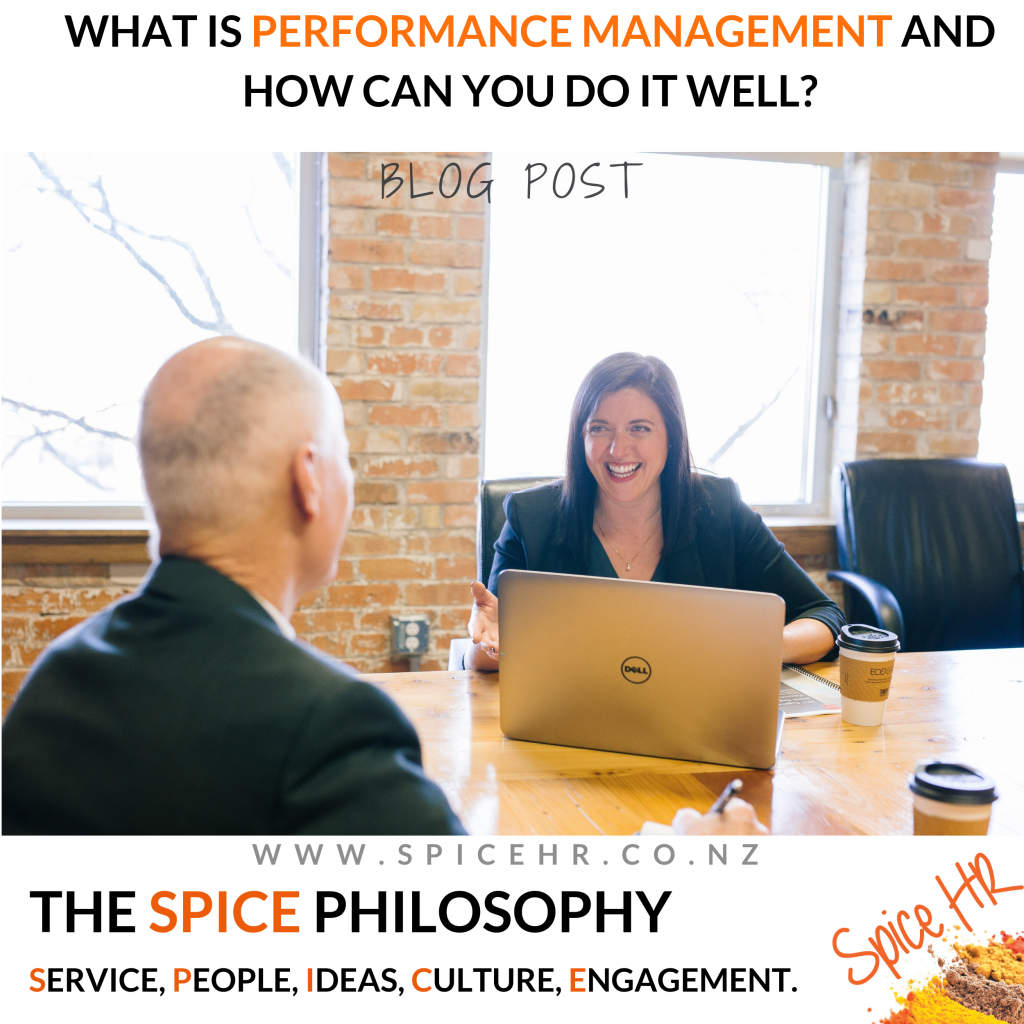
What Is Performance Management and How Can You Do It Well?


Managing the performance of your employees is one of the most essential and delicate aspects of running a successful business.

It is a little bit like adding the spice to a curry. Get it right, and you have got the perfect dish to keep everyone satisfied and powered-up. Get it wrong, and you are going to have a lot of unhappy people looking for somewhere else to eat!

While many managers find the concept of performance management intimidating, it’s actually pretty straightforward. Being transparent, authentic, open and honest are the keys to success.

Let’s have a look at some of the key ingredients for effective performance management.


What Is Performance Management?

Firstly, let’s cover off the main question… what does effective performance management look like?

Many people make the mistake of assuming that performance management is the appraisal process. But it goes far deeper than that. In fact, effective performance management is actually about creating an environment in your workplace where your team are enabled to perform to the best of their abilities.

As you can imagine, a lot goes into creating that kind of environment. It is not something you can leave to happen on its own – to magically create a great environment without any input.

So, these are our best tips on how to create the kind of space that enables your team to perform to the best of their abilities… and to want to do it!


Clarity

Would you send an invite to a dinner party but fail to include the date, time, and location? Only if you didn’t want someone to show up, right? The same goes for managing your staff. Be clear on what they are expected to achieve, how they should best go about it, and give specific deadlines.

A clear job description will help set the initial guidelines. That needs to be backed up by creating the right expectations on both sides of the relationship. Once your people know what is expected of them, they can really shine. It might help to set KPIs or goals in line with their abilities so they always have a target to strive for.


Follow-up

The days of formal annual performance reviews are fading away. Modern, effective managers are all about regular check-ins. They don’t have to be formal, structured meetings all the time (though it does help to schedule some catch ups of this nature). The point is to meet on a regular basis. This coaching method lets you catch mistakes early on, identify if people are on the right track, and help them shift attention if necessary. It allows for on-the-spot, timely feedback, and saves everyone’s time in the long run.


Feedback

While we all prefer to avoid or delay uncomfortable situations, managers need to give feedback promptly. Don’t save up your input (whether positive or negative) for a formal review when it is no longer relevant. A good mentor and coach will make use of teaching moments, giving constructive feedback as and when needed. You will find employees appreciate honesty (when delivered in a helpful, appropriate way).

Managers should also be setting a good example by actively asking for feedback from their team.


Future-Focus

While not every discussion needs to be sunshine and rainbows, it is important to ensure feedback is focused on developing skills for the future, not dwelling on what has gone wrong in the past.

When things go well, you can talk about how to repeat and build on these successes.

When challenges arise, look at ways to avoid and improve on these in the future without placing blame. Perhaps the employee can be paired up with another team member, receive further training to upskill, or be given more resources in order to meet their future objectives.


Reward and Recognition

Perhaps the most crucial part of performance management is getting the reward and recognition part right. Your employees need to feel appreciated for the work they do. Sometimes, this can be as simple as a heartfelt, individualised thank you. Other times, it may need to be a bigger incentive.

Most importantly, ensure that your rewards are fair and effective. Keep in mind that this is not a “one-size-fits-all” process. Different things motivate different people. Expend some energy finding out what works best for every individual.


If you are looking to get some structure in place when it comes to performance management at your workplace, then we can certainly help you do that. Get in touch with us here at Spice HR to enable your team to perform at their very best.